
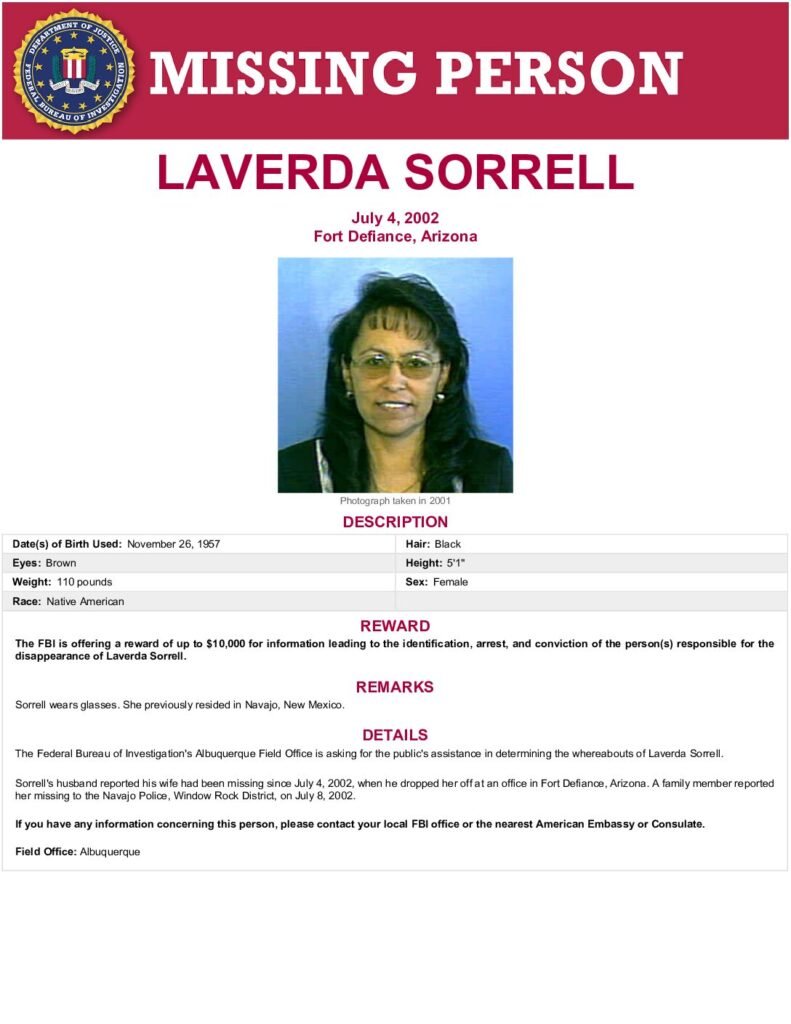
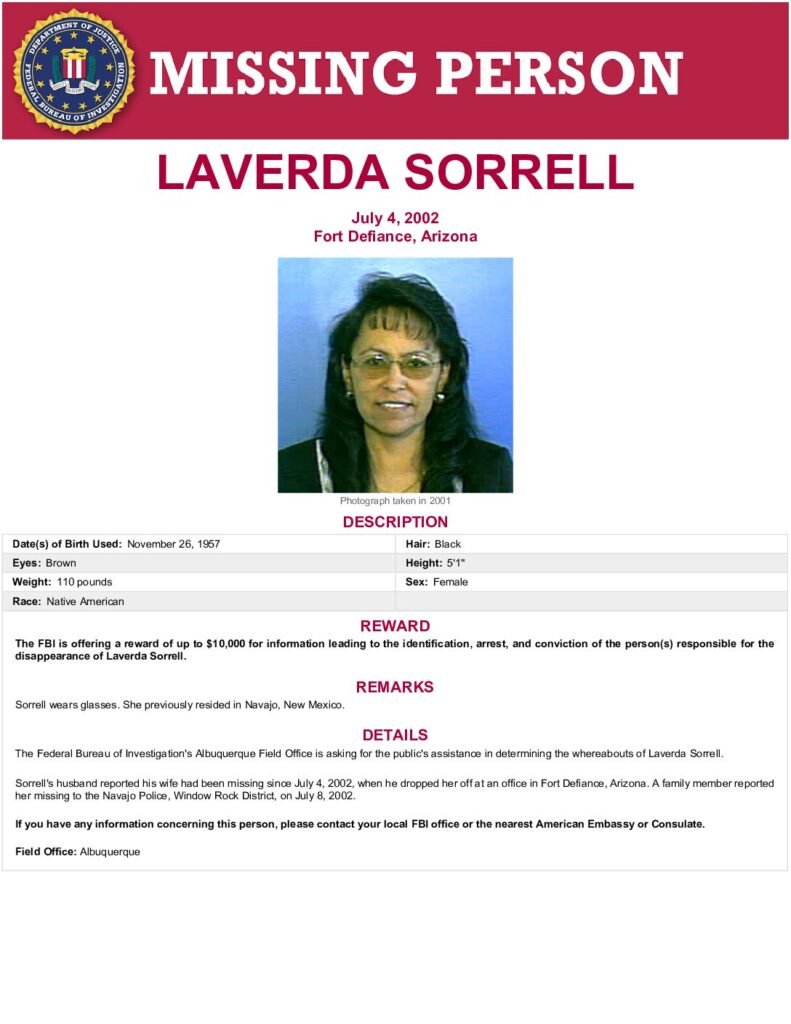
Still Missing: The Disappearance of Laverda Sorrell
On July 4, 2002, while much of the country celebrated fireworks and freedom, a Navajo family’s world quietly fell apart.
That night, 44-year-old Laverda Sorrell, a mother of three and respected community member from Fort Defiance, Arizona, vanished without a trace.
Her husband told investigators he dropped her off at her workplace — the Window Rock School District #8 office — around 11:30 p.m. after an anniversary dinner in Gallup, New Mexico. He said she wanted to check something at work. Laverda never came home.
No one saw her enter the building. No one saw her leave.
The Woman Behind the Case
By every account, Laverda was the heart of her family. She was known for her kindness, her quiet strength, and her love for her children.
“She was the glue that kept and brought our family together,” her sister Velina Guy once said. “She was everything — a daughter, a mother, a sister, an aunt — compassionate, selfless, and caring.”
It was completely out of character for Laverda to leave without calling her family. When she missed work the following Monday and didn’t contact anyone, her family knew something was wrong. Four days after she was last seen, Velina filed a missing person report with the Navajo Nation Police.
An Investigation Without Answers
From the start, questions outnumbered answers.
Why would Laverda go to her office so late at night on a holiday?
Did she have keys to get inside?
Did anyone see her car at the school?
Investigators questioned her husband — the last known person to see her alive — but no arrests were made. Over the years, new details emerged: Laverda had been open with family about wanting a divorce. She had also been seeing another man. Despite these developments, no one has ever been named a suspect, and no remains have ever been found.
For years, the case sat stagnant. The family felt ignored, like their calls for help were echoing into the void.
“There was a lot of victim-blaming,” Velina recalled in one interview. “No one really took the information seriously.”
Two decades later, the FBI reclassified the case as a homicide investigation — not just a missing person. It was a bittersweet shift. The family had always believed Laverda was taken against her will, but the acknowledgment came after years of silence.
A Family That Never Stopped Searching
Laverda’s children — Tiffany, Travis, and Treston — were just teenagers when their mother disappeared.
“I was 14 when she went missing,” Tiffany said. “At the time, I didn’t understand what was happening. I just knew something was wrong when I woke up and saw police officers in my room.”
Now adults, they’ve become advocates in their own right, continuing their aunt Velina’s tireless efforts to bring attention to their mother’s case.
In early 2024, there was a glimmer of renewed hope. The FBI assigned a new agent, and the U.S. Attorney’s Office brought in a special prosecutor dedicated to Missing and Murdered Indigenous Persons (MMIP).
Velina described the update as the most optimistic development she’d heard in years:
“We should be expecting something exciting in the near future. That speaks volumes.”
A Broader Crisis
Laverda’s story is heartbreakingly familiar across Indian Country.
According to the Urban Indian Health Institute, more than 5,700 Native American women were reported missing in 2016 — but only 116 were logged in the federal missing-person database, NamUs.
In Arizona alone, Indigenous people make up just 5% of the population but account for 21% of all missing persons cases.
The reasons are complex:
➡️ Gaps between tribal, state, and federal jurisdictions.
➡️ Inconsistent reporting systems.
➡️ Limited funding and public attention.
Laverda’s disappearance isn’t just an individual tragedy — it’s a reflection of a system that still fails too many Indigenous families.
Two Decades Later: Still Missing
It’s been more than twenty years since that July night. Laverda’s parents have passed away without knowing what happened to their daughter. Her children now have families of their own, carrying her memory forward into the next generation.
Despite the pain, they remain hopeful.
“I want her to be remembered positively because there were so many good things about her,” Tiffany said. “She’s taught us so much.”
Laverda’s case remains unsolved. The FBI continues to offer a $10,000 reward for information leading to the arrest and conviction of those responsible.
If you know anything about the disappearance of Laverda Sorrell, please contact the FBI Albuquerque Field Officeat (505) 889-1300 or submit a tip online at tips.fbi.gov.
Every Missing Person Deserves to Be Found
Laverda Sorrell was more than a case number.
She was a mother, a daughter, and a beloved sister whose absence left an empty space that time can’t fill.
Her story is one of love, strength, and resilience — and of a family that refuses to let her be forgotten.
🕯️ If you’re reading this, share her name. Tell her story. Keep her voice alive.
Have thoughts on this story or other cases you’d like to see highlighted? Share them with us in the comments or connect with us on social media. Together, we can ensure that stories like this one are never forgotten.
Don’t forget to follow us on social media, @VanishedVoicesPod, share your thoughts, and let us know what you’d like to hear about in future episodes. If you have any true crime stories of your own, send them our way Vanishedvoicespodcast@gmail.com to be featured on a future episode! And as always, Refuse to let these voices vanish. See you in the next episode of Vanished Voices!
Resources:
Primary Sources
Federal Bureau of Investigation. (2020, July 1). 18 years after Laverda Sorrell’s disappearance, FBI, Navajo Nation, and family appeal to public for answers [Press release]. FBI Albuquerque Field Office.
Federal Bureau of Investigation. (n.d.). Wanted: Laverda Sorrell. FBI.gov. Retrieved October 2025, from
Whitney, B. (2024, January 26). Newfound hope for family of missing Navajo woman after unexpected phone call. Arizona’s Family (3TV/CBS5).
Albizu, B. (2022, June 6). Family of Laverda Sorrell still hoping for justice 20 years later. KOAT Action 7 News.
Darr, K. (2022, July 4). A family’s 20-year search for answers in Laverda Sorrell’s disappearance. KGUN 9 Tucson News.
Weber, L. (2020, July 5). FBI, family seek clues about woman who went missing 18 years ago. The Journal.
ICT Press Pool. (2020, July 1). 18 years after Laverda Sorrell’s disappearance, FBI, Navajo Nation, and family appeal to public for answers. ICT News.
Arizona’s Family (Producers). (2023, July 10). The forgotten: Where is Laverda Sorrell? [Audio podcast episode]. In True Crime Arizona. Arizona’s Family.
Arizona & MMIW Context
Urban Indian Health Institute. (2018). Missing and murdered Indigenous women & girls: A snapshot of data from 71 urban cities in the United States. Seattle Indian Health Board.
Arizona Mirror. (2024, December 3). After years of funding with little headway, Indigenous women still missing and murdered at alarming rates. Arizona Mirror.
Arizona Luminaria. (2024, October 31). “I didn’t forget her”: Missing San Carlos Apache teen identified after 41 years.
Arizona State University, Center for Correctional Solutions. (2020, November). Reducing missing and murdered Indigenous women and girls (MMIWG): A review of the research and policy recommendations. Arizona State University.
Bureau of Indian Affairs. (2023). Missing and Murdered Indigenous People Crisis – Overview. U.S. Department of the Interior.
National Congress of American Indians. (2020). Key statistics and background on violence against American Indian and Alaska Native women. NCAI.
Government Accountability Office. (2016). Missing Persons and Unidentified Remains: Opportunities May Exist to Share Information More Efficiently | U.S. GAO. GAO-16-515.
Additional Advocacy & Policy Resources
Hobbs, K. (2023, March 7). Governor Hobbs establishes task force to address missing and murdered Indigenous people in Arizona. Office of the Governor, State of Arizona.
Department of Justice. (2019, November 22). Attorney General William P. Barr launches Missing and Murdered Indigenous Persons Initiative. U.S. Department of Justice.
Navajo Nation Council. (2022). Navajo Nation Missing Persons and Murdered Diné Relatives Task Force annual report. Navajo Nation.