Published by Vanished Voices | True Crime | Missing Persons | Racial Justice
There is a version of this story that most of America never heard.
A sixteen year old girl. Straight-A student. Athlete. The kind of teenager who made everyone around her believe the future was going to be just fine. She traveled from her hometown in North Carolina to Baltimore to spend Christmas with her older half-sister. She had made the trip before. There was nothing unusual about it. Nothing that should have made anyone afraid.
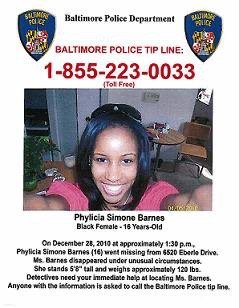
On December 28th, 2010, Phylicia Simone Barnes stepped out of her sister’s apartment in northwest Baltimore and never came back.
And for reasons that have everything to do with race and nothing to do with newsworthiness — the country barely noticed.
Who Was Phylicia Barnes?
Before we talk about what happened to Phylicia, we need to talk about who she was. Because that is something the national media never gave the world a proper chance to do.
Phylicia was born on January 12th, 1994, in Monroe, North Carolina — a mid-sized city about twenty miles southeast of Charlotte. She was a straight-A student and an athlete. A college scholarship was ahead of her. Her father, Russell Barnes, described her with the particular mix of pride and tenderness that tells you everything about who a person was to the people who loved them most.
She was not a case number. She was not a statistic. She was a real, specific, irreplaceable person with a future that should have been long and full and entirely hers.
That matters. It matters more than anything else in this story. And it is the thing that gets lost when the media decides a missing person is not worth covering.
The Disappearance
On the afternoon of December 28th, 2010, Phylicia left her half-sister Deena’s apartment. Before she went, she posted on Facebook — she was at her sister’s place, she was fine. That post is the last confirmed contact anyone had with her.
She was sixteen years old.
What followed was one of the most extensive missing persons searches Baltimore had seen in years. Baltimore City Police, the FBI, and Maryland State Police all became involved within days. Helicopters swept the area. Investigators pulled security footage from the surrounding neighborhood. A reward climbed to thirty-six thousand dollars. Billboards went up along major highways in Maryland and North Carolina.
And yet — outside of Baltimore and Monroe — the country was almost entirely silent.
Her family’s spokesperson said publicly what everyone could already see: “This case is no different than the Natalee Holloway case. The only difference is Phylicia is from North Carolina, she went missing in Baltimore, and she is African-American.”
A Baltimore police spokesman echoed the sentiment on the record. America’s Most Wanted aired a brief commercial mention — not a feature, not a full segment. A commercial mention.
That was it.
Missing White Woman Syndrome — By Name
There is a term for what happened to Phylicia Barnes’ media coverage. Scholars and journalists call it Missing White Woman Syndrome — the well-documented pattern in which missing white women, particularly young, middle class, and conventionally attractive ones, receive wall-to-wall national media attention while missing Black and brown women and girls are effectively invisible.
The research backs this up. The Black and Missing Foundation has documented that Black Americans account for roughly a third of all missing persons cases in the United States — while receiving a fraction of the media coverage.
That gap is not accidental. It is the result of decades of editorial decisions, unconscious bias baked into newsroom culture, and a failure to treat Black lives as equally urgent, equally newsworthy, equally worthy of the nation’s grief.
And it has consequences. Media coverage in missing persons cases is not just symbolic — it is operational. More coverage generates more tips. More tips generate more leads. More leads create more pressure on law enforcement to move quickly. When Phylicia’s family was pitching her story to national outlets starting December 29th and couldn’t get traction — they weren’t just being denied attention. They were being denied the machinery that helps find missing people.
The Discovery
One hundred and thirteen days after Phylicia disappeared, workers near the Conowingo Dam on the Susquehanna River — about an hour northeast of Baltimore — spotted something in the water.
It was Phylicia.
The Office of the Chief Medical Examiner ruled her death a homicide. The specific cause of death was withheld by investigators — a deliberate decision to protect the integrity of the investigation. What emerged during later trial testimony pointed to asphyxiation, with drowning debated due to limited forensic indicators of physical trauma.
She had been found unclothed. In a river. Nearly an hour’s drive from the apartment where she was last seen alive.
Someone had killed her. Someone had put her there. And investigators believed they knew who.
Three Trials. No Justice.
Michael Johnson — Deena’s boyfriend of ten years, a man who lived intermittently in that apartment and was the last known person to see Phylicia alive — was arrested in April 2012 and charged with murder.
What followed was nearly a decade of legal proceedings that the Barnes family had to survive through.
Trial One, in 2013, produced a conviction — second degree murder. That conviction was overturned on appeal within a year. Trial Two, in 2015, ended in a mistrial, and then in the extraordinary step of all charges being dropped entirely by the judge. The Court of Special Appeals later determined that decision was made in error, and charges were reinstated. Trial Three, in 2018, ended in a full acquittal. The judge said there were too many unanswered questions for any fact-finder to find Johnson guilty beyond a reasonable doubt.
Michael Johnson walked free.
The Barnes family had spent eight years living inside this case. Eight years of courtrooms, of testimony, of hope rising and collapsing again and again.
And at the end of it — nothing.
Closed is not the same as solved. Solved is not the same as just.
What Phylicia Left Behind
Here is the part of the story that the media — on the rare occasions it covered this case at all — never gave enough space to.
The Barnes family did not collapse. They converted their grief into something lasting.
In 2012, the Maryland General Assembly passed Phylicia’s Law — legislation requiring better coordination between law enforcement and community organizations when a child goes missing. Closing the gaps. Making the system work better for the next family in their position.
Phylicia’s half-brother Bryan was so moved by the dedication of the detectives who worked her case that he joined the Baltimore Police Department in 2012. He wanted to be that for someone else.
And her father Russell — who promised from the very beginning that he would turn the city upside down to find his daughter — never stopped saying her name. Never stopped pushing. Never stopped making sure that Phylicia Simone Barnes was remembered as a person and not just a case file.
Because of them, Phylicia’s name is written into Maryland law. Because of them, a young man chose to dedicate his life to bringing answers to grieving families. Because of them — and because of podcasts like this one — her story is still being told.
Listen. Share. Act.
The full story of Phylicia Barnes is told across two episodes of Vanished Voices. Part One covers her life, her disappearance, and the media failure that shaped everything that followed. Part Two covers the discovery of her body, the three trials, and the legacy her family built in her name.
Both episodes are available now wherever you listen to podcasts.
If you have any information about the murder of Phylicia Simone Barnes, please contact Baltimore Metro Crime Stoppers at 1-866-7LOCKUP. You can remain completely anonymous.
Resources:
- Black and Missing Foundation — blackandmissinginc.com
- The Conscious Kid — theconsciouskid.org
- Sovereign Bodies Institute — sovereignbodies.org
- National Center for Missing & Exploited Children — missingkids.org | 1-800-843-5678
Vanished Voices is a true crime podcast dedicated to the cases that don’t get the attention they deserve — unsolved cases of people of color, LGBTQ+ victims, MMIW cases, and stories that still need tips to be solved. New episodes drop every Thursday. Subscribe and follow us anywhere you listen to podcasts.
Have thoughts on this story or other cases you’d like to see highlighted? Share them with us in the comments or connect with us on social media. Together, we can ensure that stories like this one are never forgotten.
Start with Part 1 of Phylicia’s full case on Apple Podcast, Spotify, Amazon Music, YouTube or anywhere you get your podcasts!
Don’t forget to follow us on social media, @VanishedVoicesPod, share your thoughts, and let us know what you’d like to hear about in future episodes. If you have any true crime stories of your own, send them our way Vanishedvoicespodcast@gmail.com to be featured on a future episode! And as always, Refuse to let these voices vanish. See you in the next episode of Vanished Voices!
Resources:
News Sources
The Baltimore Sun — Comprehensive Case Archive The Sun has the most thorough ongoing coverage of this case from disappearance through acquittal and beyond.
- Sun Coverage: Phylicia Barnes — Full archive of Baltimore Sun reporting on the case Sun coverage: Phylicia Barnes – Baltimore Sun
- Baltimore Judge Acquits Man Accused of Killing Phylicia Barnes (March 30, 2018) Baltimore Judge Acquits Man Accused of Killing Phylicia Barnes
- Second Trial in Phylicia Barnes Murder Begins Without Key Witness Second Trial in Phylicia Barnes Murder Begins Without Key Witness
- Tape Shows Accused Killer’s Desire for Barnes, Prosecution Says (January 25, 2013)Tape shows accused killer’s desire for Barnes, prosecution says – Baltimore Sun
- Prosecutors Say Sex Video Includes Phylicia Barnes, Alleged Killer (December 28, 2012) Prosecutors Say Sex Video Includes Phylicia Barnes, Alleged Killer
- Lead Detective in Barnes Case Charged in 2012 Incident Lead Detective in Barnes Case Charged in 2012 Incident
- Man Tried Three Times in Phylicia Barnes Killing Charged with Rape in Baltimore County (July 2024) Man tried three times in Phylicia Barnes killing is charged with rape in Baltimore County
- Phylicia Barnes Articles Index Phylicia Barnes Articles Index
CBS News Baltimore / WJZ
- Michael Johnson Acquitted in 3rd Phylicia Barnes Murder Trial (March 31, 2018) Michael Johnson Acquitted In 3rd Phylicia Barnes Murder Trial – CBS Baltimore
- Man Cleared in Teen’s 2010 Slaying Now Accused of Unrelated Rape, Strangling (2024) Man Cleared in Teen’s 2010 Slaying Now Accused of Unrelated Rape, Strangling
- Man Acquitted of Phylicia Barnes’ Murder Set for Trial Again in Baltimore County (2025) Man acquitted of Phylicia Barnes’ murder set for trial again for attempted killing in Baltimore County
- Phylicia Barnes’ Family in Courtroom as Man Acquitted of Her Murder Is on Trial in Baltimore County (April 2025) Phylicia Barnes’ family in courtroom as man acquitted of her murder is on trial in Baltimore County
- Victim Testifies Man Acquitted in Phylicia Barnes’ Murder Strangled, Raped Her (April 2025) Victim testifies man acquitted in Phylicia Barnes’ murder strangled, raped her in Baltimore County apartment
- Phylicia Barnes’ Sister Speaks About Emotional Return to Court (April 2025) Phylicia Barnes’ Sister Speaks About Emotional Return to Court
- Phylicia Barnes Murder Trial: Witness to Testify Missing Teen Was Seen Alive Phylicia Barnes Murder Trial: Witness to Testify Missing Teen Was Seen Alive
Fox Baltimore / WBFF
- Family of Phylicia Barnes Reacts to New Charges Against Her Accused Killer (July 2024) Family of Phylicia Barnes reacts to new charges against her accused killer
- Fox Baltimore — Murder of Phylicia Barnes Topic Page Baltimore Topic Murder Of Phylicia Barnes | News, Weather, Sports, Breaking News
The Baltimore Banner
- Michael Maurice Johnson: Man Cleared in Phylicia Barnes Case Faces New Charges (July 2024) Michael Maurice Johnson: Man cleared in Phylicia Barnes case faces new charges – The Banner
WBTV / Charlotte Observer
- Baltimore Judge Acquits Man Accused of NC Teen Phylicia Barnes’ Murder (March 2018) Baltimore judge acquits man accused of NC teen Phylicia Barnes’ murder
Additional Resources:
Barnes, R. (2011, April 21). Statement on the recovery of Phylicia Barnes. Baltimore City Police Department Press Conference.
Black and Missing Foundation. (2023). Missing and unheard: Racial disparities in missing persons coverage. blackandmissinginc.com
Bosman, J. (2011, April 21). Body found in river identified as missing Maryland teenager. The New York Times.https://www.nytimes.com
Carter, J. P. (2012). Phylicia’s Law: House Bill 964. Maryland General Assembly. https://mgaleg.maryland.gov
Chiricos, T., & Eschholz, S. (2002). The racial and ethnic typification of crime and the criminal typification of race and ethnicity in local television news. Journal of Research in Crime and Delinquency, 39(4), 400–420. https://doi.org/10.1177/002242702237286
Entman, R. M., & Rojecki, A. (2000). The Black image in the white mind: Media and race in America. University of Chicago Press.
Federal Bureau of Investigation. (2011). Missing persons statistics: Annual report. U.S. Department of Justice. https://www.fbi.gov
Frisby, C. M. (2017). Missing white woman syndrome: An empirical analysis of race and gender disparities in online news coverage of missing persons. Journal of Mass Communication & Journalism, 7(1), 1–8. https://doi.org/10.4172/2165-7912.1000332
Goff, P. A., Jackson, M. C., Di Leone, B. A. L., Culotta, C. M., & DiTomasso, N. A. (2014). The essence of innocence: Consequences of dehumanizing Black children. Journal of Personality and Social Psychology, 106(4), 526–545. https://doi.org/10.1037/a0035663
Gross, K., & Aday, S. (2003). The scary world in your living room and neighborhood: Using local broadcast news, neighborhood crime rates, and personal experience to test agenda setting and cultivation. Journal of Communication, 53(3), 411–426. https://doi.org/10.1111/j.1460-2466.2003.tb02599.x
Liebler, C. M. (2010). Me(di)a culpa?: The “missing white woman syndrome” and media self-critique. Communication, Culture & Critique, 3(4), 549–565. https://doi.org/10.1111/j.1753-9137.2010.01085.x
Maryland Office of the Chief Medical Examiner. (2011). Homicide ruling: Phylicia Simone Barnes. Maryland Department of Health.
Maryland State Police. (2011). Missing persons investigation: Phylicia Barnes case file summary. Maryland Department of Public Safety and Correctional Services.
Missing Kids. (2023). Missing children statistics and resources. National Center for Missing & Exploited Children. https://www.missingkids.org
National Center for Missing & Exploited Children. (2022). 2022 missing children statistics.https://www.missingkids.org/footer/media/keyfacts
Oliver, M. B. (1999). Caucasian viewers’ memory of Black and White criminal suspects in the news. Journal of Communication, 49(3), 46–60. https://doi.org/10.1111/j.1460-2466.1999.tb02800.x
Owens, E. (2011, January 14). Family says media ignoring missing Black teen Phylicia Barnes. The Daily Caller.
Pew Research Center. (2021). Race and ethnicity in local TV news. https://www.pewresearch.org
Romer, D., Jamieson, K. H., & Aday, S. (2003). Television news and the cultivation of fear of crime. Journal of Communication, 53(1), 88–104. Television news and the cultivation of fear of crime
Sovereign Bodies Institute. (2023). MMIWG2S+ data & research. https://www.sovereignbodies.org
U.S. Department of Justice. (2022). Missing and unidentified persons: National statistics. Office of Justice Programs. https://www.ojp.gov
Walsh, J. (2011, January). America’s Most Wanted: Phylicia Barnes segment. America’s Most Wanted Productions.
Washington, J. (2011, May 3). Race a factor in coverage of missing persons cases. Associated Press.
Williams, L. (2018, March 15). Judge acquits Michael Johnson in Phylicia Barnes murder case. The Baltimore Sun.
Wilson, D., & Wilson, N. (2022). Black and missing: A documentary. HBO Documentary Films.